



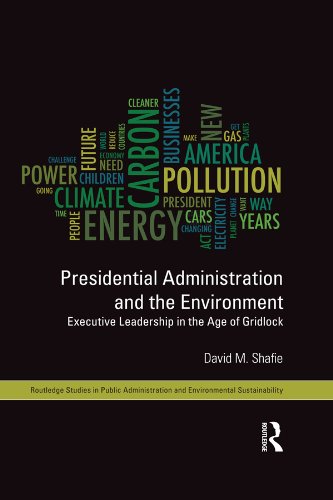
Presidential Administration and the Environment: Executive Leadership in the Age of Gridlock (Routledge Studies in Public Administration and Environmental Sustainability) 1st Edition, Kindle Edition

 4.5 (110 items)
 Limited Time Sale
$34.79 cheaper than the new price!!
Free cash-on-delivery fees for purchases over $99
Product details
| Management number | 222239540 | Release Date | 2026/05/04 | List Price | $23.20 | Model Number | 222239540 | ||
|---|---|---|---|---|---|---|---|---|---|
| Category | |||||||||
After sweeping environmental legislation passed in the 1970s and 1980s, the 1990s ushered in an era when new legislation and reforms to existing laws were consistently caught up in a gridlock. In response, environmental groups became more specialized and professional, learning how to effect policy change through the courts, states, and federal agencies rather than through grassroots movements. Without a significantly mobilized public and with a generally uncooperative Congress, presidents since the 1990s have been forced to step into a new role of increasing presidential dominance over environmental policies. Rather than working with Congress, presidents instead have employed unilateral actions and administrative strategies to further their environmental goals.Presidential Administration and the Environment offers a detailed examination of the strategies and tools used by U.S. presidents. Using primary sources from presidential libraries such as speeches and staff communications, David M. Shafie analyzes how presidents such as Bill Clinton and George W. Bush have used alternative executive approaches to pass environmental policies. From there, Shafie presents case studies in land management, water policy, toxics, and climate change. He analyzes the role that executive leadership has played in passing policies within these four areas, explains how this role has changed over time, and concludes by investigating how Obama’s policies compare thus far with those of his predecessors.Shafie’s combination of qualitative content analysis and topical case studies offers scholars and researchers alike important insights for understanding the interactions between environmental groups and the executive branch and the implications for future policymaking in the United States. Read more
Bestseller ranking
Leadership




Customers who viewed this product also viewed
Rucksäcke


Correction of product information
If you notice any omissions or errors in the product information on this page, please use the correction request form below.
Correction Request Form